GLP-1 Support Specialty Consultation
GLP-1 medications are powerful tools for weight loss. But while they reduce what you eat, they don't reduce what your body requires — and the gap that creates is real, predictable, and specific to you. This consultation identifies your nutritional risks and builds the stack to close them.
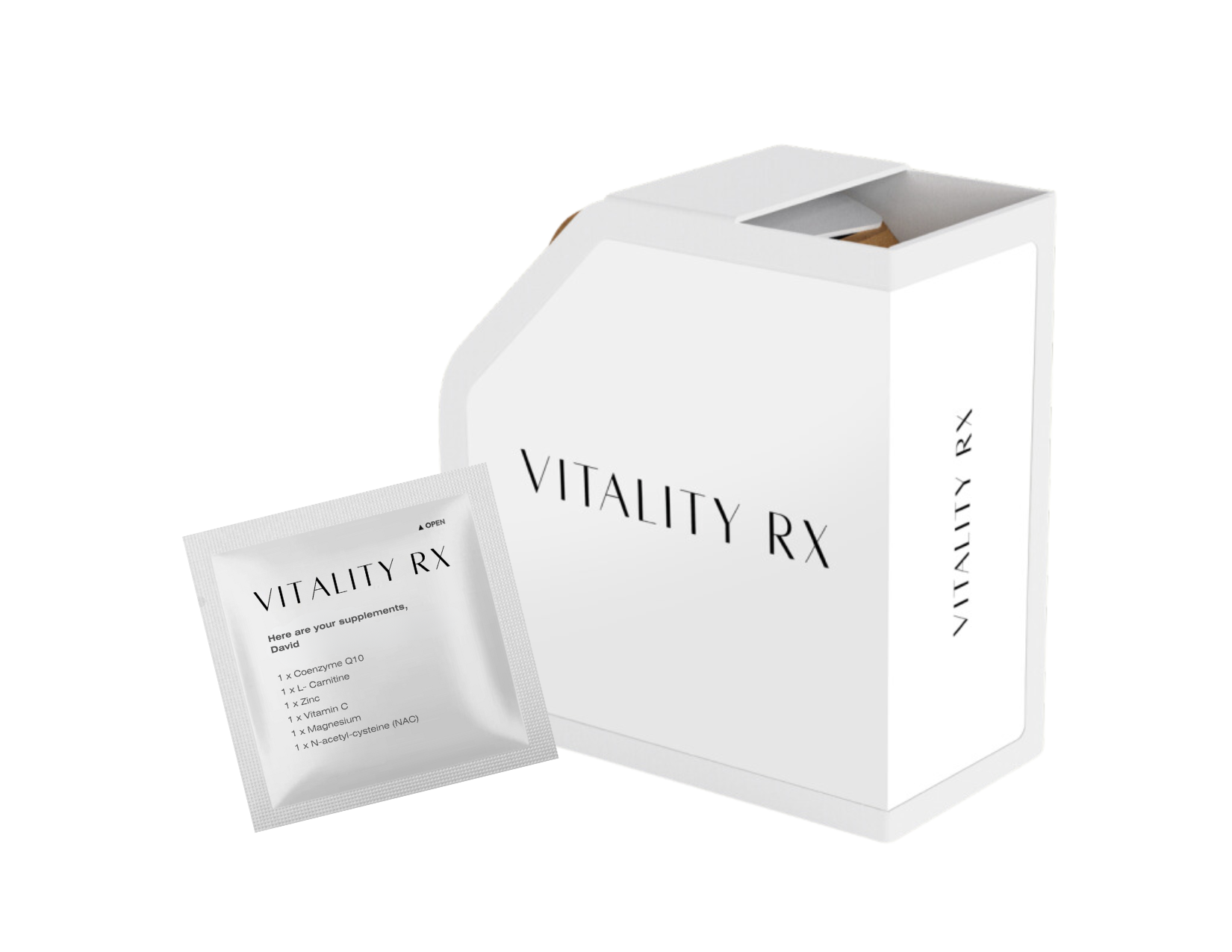
WHY THIS ISN'T ONE-SIZE-FITS-ALL
GLP-1 therapy creates nutritional demands that vary significantly by person. Your phase of treatment, your biology, your other medications, and your primary concerns all determine what your body actually needs.
The first 90 days on a GLP-1 look nothing like month six. Early phase priorities are gut support and electrolyte balance. Active weight loss demands muscle preservation. Long-term therapy surfaces deeper micronutrient depletion. The stage matters.
Women on GLP-1s face a distinct risk landscape — hair thinning, bone density loss, hormonal disruption, and iron depletion are documented and predictable. Men carry a higher lean mass risk. Biology is one of the most important inputs into your stack.
Statins create a documented CoQ10 depletion. Metformin impairs B12 absorption over time. Blood pressure medications affect electrolyte balance. If you're on other medications alongside a GLP-1, your stack needs to account for the combined picture.
Severe appetite suppression means most patients fall well short of protein targets — but how short varies significantly. Plant-based patients face additional considerations. Your dietary patterns tell us how much of the foundation is already covered and what the gaps actually are.
Fatigue, hair thinning, muscle weakness, GI disruption, and brain fog each point to different underlying gaps. What you're currently experiencing isn't noise — it's clinical signal. Your symptoms are one of the most direct inputs into what your stack should prioritize.
Whether you're focused on managing side effects, protecting muscle during active loss, optimizing for longevity on the medication, or preparing to eventually discontinue — each goal requires a meaningfully different supplementation approach.
THE CLINICAL PICTURE
The medication is working. The question is what it's working with. Eating significantly less doesn't change what your body needs — and in many cases, those needs are higher because of the rapid metabolic adaptation the drug demands.
Clinical trials show that without protective intervention, 25–40% of total weight lost on GLP-1s comes from lean mass — not fat. For a patient losing 40 lbs, that's up to 16 lbs of muscle. That outcome doesn't show on the scale as failure. But it sets the stage for everything that comes next: metabolic slowdown, reduced strength, hormonal disruption, and rebound weight gain when the medication stops.
GLP-1s slow gastric emptying and suppress appetite significantly. B12 absorption is directly impaired. Fat-soluble vitamins — D, K2, A — drop alongside reduced fat intake. Magnesium Glycinate, zinc, and electrolytes are lost through GI side effects. The gap between what you're consuming and what your body requires is real, predictable, and specific. It's also addressable with the right supplementation protocol.
Muscle tissue burns calories at rest. When you lose it, your resting metabolic rate drops. When the medication is eventually discontinued, that lowered metabolism meets a returning appetite. This is the documented rebound mechanism — and it's the reason what you do during treatment determines your long-term results. Supplementation during GLP-1 therapy isn't an add-on. It's the clinical infrastructure that determines whether the outcome holds.
GLP-1 supplementation isn't about losing weight faster or amplifying the drug. It's about losing the right weight — keeping your muscle, protecting your metabolism, and coming off the medication in better health than you started.
For Women on GLP-1 Therapy
Women on GLP-1 therapy face a distinct set of concerns that go beyond lean mass. Hair thinning, bone density loss, hormonal disruption, and iron depletion are documented and predictable — but they're rarely discussed at the point of prescription.
Our consultation accounts for all of it. The questions you answer shape a stack built around your specific risk profile — not a generic GLP-1 protocol.
Men on GLP-1 therapy have their own risk profile too — cardiovascular protection, creatine for muscle preservation, and medication-specific depletions. The consultation covers both.
Telogen effluvium — diffuse shedding that typically appears 2–4 months into treatment — is one of the most reported concerns among women on GLP-1s. It's driven by rapid caloric restriction, protein deficit, and iron depletion rather than the drug itself. Biotin, iron, and adequate protein address all three root causes.
Rapid weight loss accelerates bone turnover. For perimenopausal and postmenopausal women, this compounds an existing vulnerability. Calcium, D3, K2, and Magnesium Glycinate work together to protect bone mineral density — and the window to act is during active treatment, not after significant loss has already occurred.
Significant fat reduction alters estrogen production. Combined with the metabolic stress of rapid weight loss, this can affect thyroid function, cortisol balance, and sleep quality. Adaptogens, B-complex, and targeted minerals support hormonal resilience throughout the treatment window.
Women have higher baseline iron requirements, and GLP-1 therapy compounds the risk by reducing red meat intake and altering gut absorption. Iron-deficiency fatigue is common on GLP-1s and frequently misattributed to the medication. Our women's protocol includes Easy Iron — a gentle, non-constipating form that doesn't add GI burden on top of existing side effects.